
01 / VERIFICATION
Establish who you are dealing with
Begin with the business name used in contracts, registration details and the legal entity that will invoice you. Check whether the supplier is a manufacturer, trading company or hybrid operation. None of those models is automatically unsuitable; what matters is visibility over where goods are made and who remains accountable.
For critical orders, request an independent verification of the legal entity and relevant operating address. Do not rely on a website, product catalogue or messaging profile as proof of identity.
Action checklist
- Compare company registration, quotation and payment beneficiary details.
- Ask who owns production decisions and quality sign-off.
- Use independent verification when order exposure justifies it.
02 / CAPABILITY
Test product and process capability
Ask the supplier to describe the production method, capacity constraints, quality controls and available certifications relevant to the product. A certificate should be checked for scope, validity and issuing body; it should not be treated as a blanket guarantee.
Provide a consistent specification and ask targeted questions about materials, tolerances, testing and substitutions. A sample order can reveal quality and communication gaps, but a good sample does not by itself prove volume-production consistency.
Action checklist
- Use the same RFQ package across shortlisted suppliers.
- Review samples against measurable acceptance criteria.
- Confirm any outsourced manufacturing or testing steps.
03 / COMMERCIAL FIT
Look beyond the quoted number
Clarify minimum order quantity, lead-time assumptions, tooling ownership, packaging, payment terms, warranty expectations and remedies for non-conforming goods. Consider whether the supplier can support repeat orders and product revisions.
A price that seems unusually low can indicate a scope difference. Request a line-by-line explanation before treating it as a saving.
Action checklist
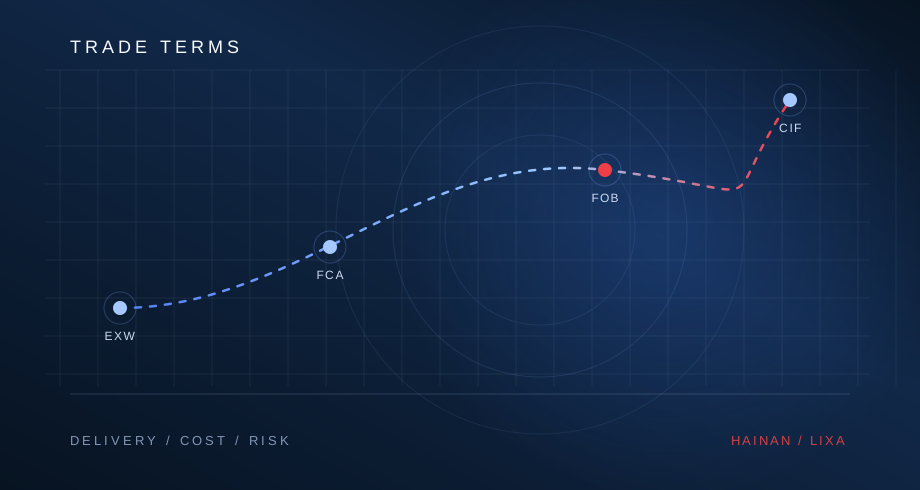
- Compare landed-cost components on the same trade terms.
- Define who pays for rework, replacements and inspections.
- Document any exclusivity or tooling arrangements.
04 / COORDINATION
Use communication as a stress test
A credible supplier should be able to explain what happens when the buyer changes a specification, the factory misses a milestone or inspection reveals a defect. Ask for named points of contact and escalation rules.
Pay attention to whether responses resolve the question or merely repeat reassuring claims. Detailed and consistent communication is a stronger basis for cooperation than fast replies alone.
Action checklist
- Ask for a proposed production and update schedule.
- Require written approval for substitutions.
- Record decisions in one shared document trail.
05 / VALIDATION
Start with a controlled order
Where commercially reasonable, use a pilot order to test production, packaging, inspection and documentation. Evaluate how the supplier responds to issues rather than judging the order only by whether it eventually ships.
If you plan to scale, preserve the approved sample, drawings and test methods so later batches have a stable reference.
Action checklist
- Review performance after the first shipment.
- Track deviations and corrective actions.
- Reassess capacity before increasing order volume.
Clarity creates room to move.
A coordinated trade process starts with shared expectations and ends with a documented handover. These guides offer general business information; product-specific compliance, contractual and customs decisions should be confirmed with qualified specialists.